
Why Prediction Market Prices Can Collapse as the Deadline Gets Closer
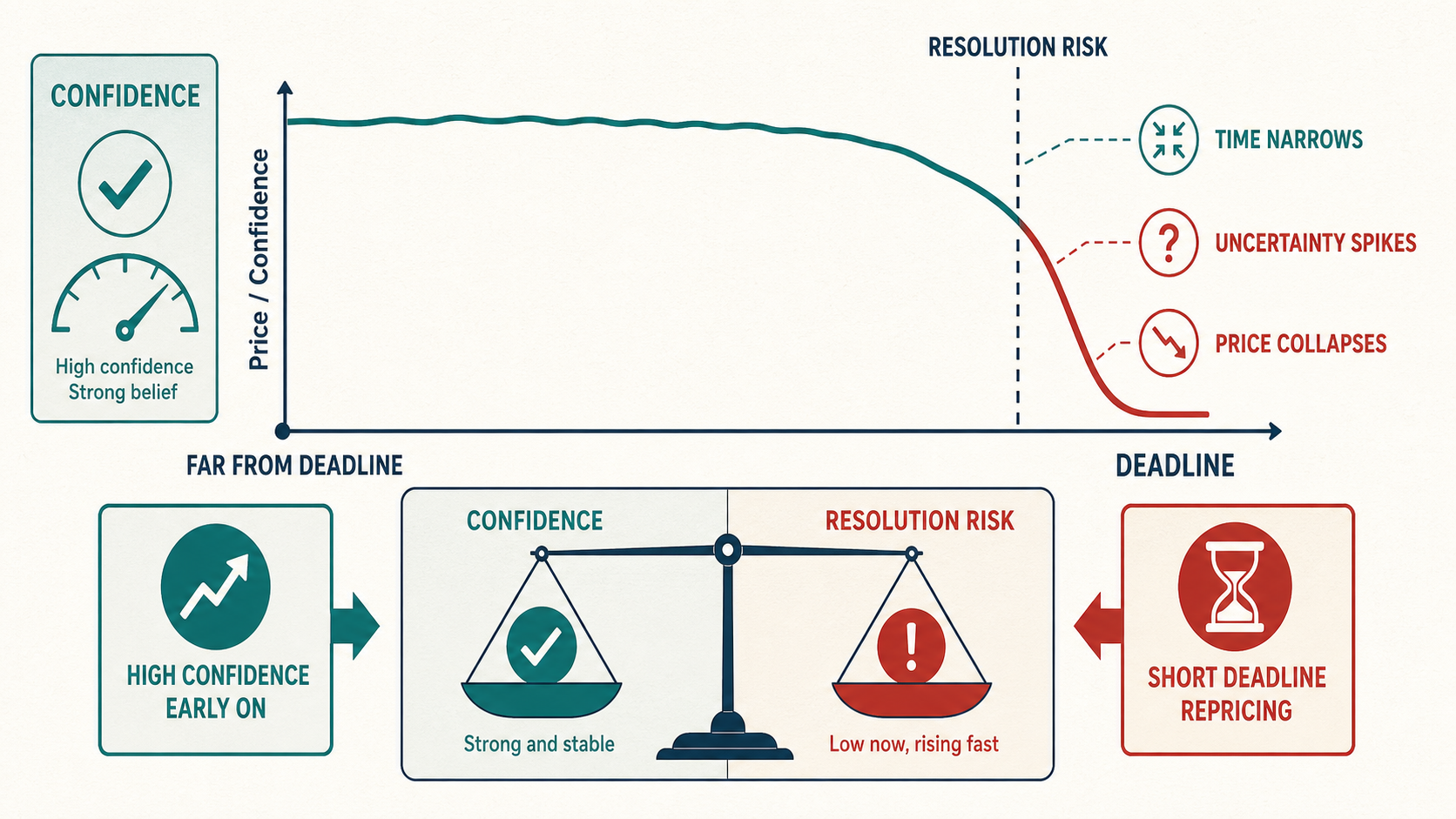
On current Polymarket Breaking boards, some of the hardest moves are coming from contracts with tight deadlines. The real lesson is not just that traders saw a headline. It is that the remaining Yes-paths are shrinking fast.
Why this article exists now
This article exists now because current Polymarket Breaking boards are clustering around the same repricing logic. The useful beginner move is to stop reading these as isolated headlines and start reading them as examples of one repeatable market mechanism.
How this explainer was built
This explainer uses current Polymarket Breaking questions as examples, then abstracts the repeatable mechanism behind them. It is not a prediction, endorsement, or betting recommendation. The goal is to help beginners read contract wording, timing, and evidence quality more clearly.
Current pattern on Breaking
The visible pattern right now is a cluster of deadline-driven contracts that all become much harsher to price once the remaining calendar window narrows.
- Will Russia capture Pokrovka by July 31?
On the surface this looks like a headline market. Underneath, it is a short deadline repricing case where traders are repricing the narrowing contract path rather than just reacting to vibes.
The mechanism evidence is that the board cares less about general relevance and more about whether the exact Yes route still exists in time. - Will there be no next Google Gemini Pro model release by July 31, 2026?
On the surface this looks like a headline market. Underneath, it is a short deadline repricing case where traders are repricing the narrowing contract path rather than just reacting to vibes.
The mechanism evidence is that the board cares less about general relevance and more about whether the exact Yes route still exists in time. - Will 30 ships transit the Strait of Hormuz on any day by July 31, 2026?
On the surface this looks like a headline market. Underneath, it is a short deadline repricing case where traders are repricing the narrowing contract path rather than just reacting to vibes.
The mechanism evidence is that the board cares less about general relevance and more about whether the exact Yes route still exists in time. - Will Ed Miliband be the next Chancellor of the Exchequer of the UK in 2026?
On the surface this looks like a headline market. Underneath, it is a short deadline repricing case where traders are repricing the narrowing contract path rather than just reacting to vibes.
The mechanism evidence is that the board cares less about general relevance and more about whether the exact Yes route still exists in time.
What the market is actually repricing
The mechanism evidence is that every missed hour removes plausible Yes-paths, so the board reprices path count rather than sentiment alone.
- every missed hour removes possible Yes-paths
- procedural or operational routes disappear in batches rather than smoothly
- the market starts pricing remaining path count, not just headlines
Diagnostic framework
| What to check | Why it matters | Beginner mistake to avoid |
|---|---|---|
| Ask how many realistic Yes-paths still exist before the cutoff. | This tells you whether the contract path is still alive, not just whether the headline is interesting. | Treating a broad story as enough evidence for the exact contract. |
| Check whether the remaining path depends on a formal action, announcement, or measurable event. | This tells you whether the contract path is still alive, not just whether the headline is interesting. | Treating a broad story as enough evidence for the exact contract. |
| Separate the broader story from the exact contract deadline. | This tells you whether the contract path is still alive, not just whether the headline is interesting. | Treating a broad story as enough evidence for the exact contract. |
What beginners usually misread
The beginner mistake is to read a sharp move like pure drama or pure fresh information. In most Breaking-style contracts, the better explanation is that the market has started pricing a narrower path structure. That is why a contract can feel calm one day and brutally decisive the next.
What this move does not prove
It does not prove the earlier price was stupid. It usually proves the contract used to have more live paths than it has now.
How to read the next one better
- Ask what exact condition still needs to happen for Yes to resolve.
- Ask how many realistic paths remain, not just whether the story still feels alive.
- Do not confuse broad relevance with contract relevance.
- Treat disappearing time as real information, not just background context.
What to read next
Use this as a reading path: identify the contract trigger, identify the remaining time window, then identify how many realistic Yes-paths are still alive before you infer anything from the price move.
- Ask how many realistic Yes-paths still exist before the cutoff.
- Check whether the remaining path depends on a formal action, announcement, or measurable event.
- Separate the broader story from the exact contract deadline.
- Start with What Is a Prediction Market? A Beginner’s Guide to Event Contracts
- Browse the PredictionMarket.zone beginner guides
- Browse the complete PredictionMarket.zone article library