What Is a Prediction Market? A Beginner’s Guide to Event Contracts
A prediction market is a place where people trade contracts tied to a specific future event. Instead of buying a company share or a commodity, participants buy and sell a clearly defined outcome, such as whether a policy will pass, whether inflation will exceed a stated level by a stated date, or whether a product will launch before a deadline. The goal for a beginner is not to treat the market as magic. It is to understand what the contract says, how prices move, how settlement works, and what information a price may reflect.
What an event contract actually is
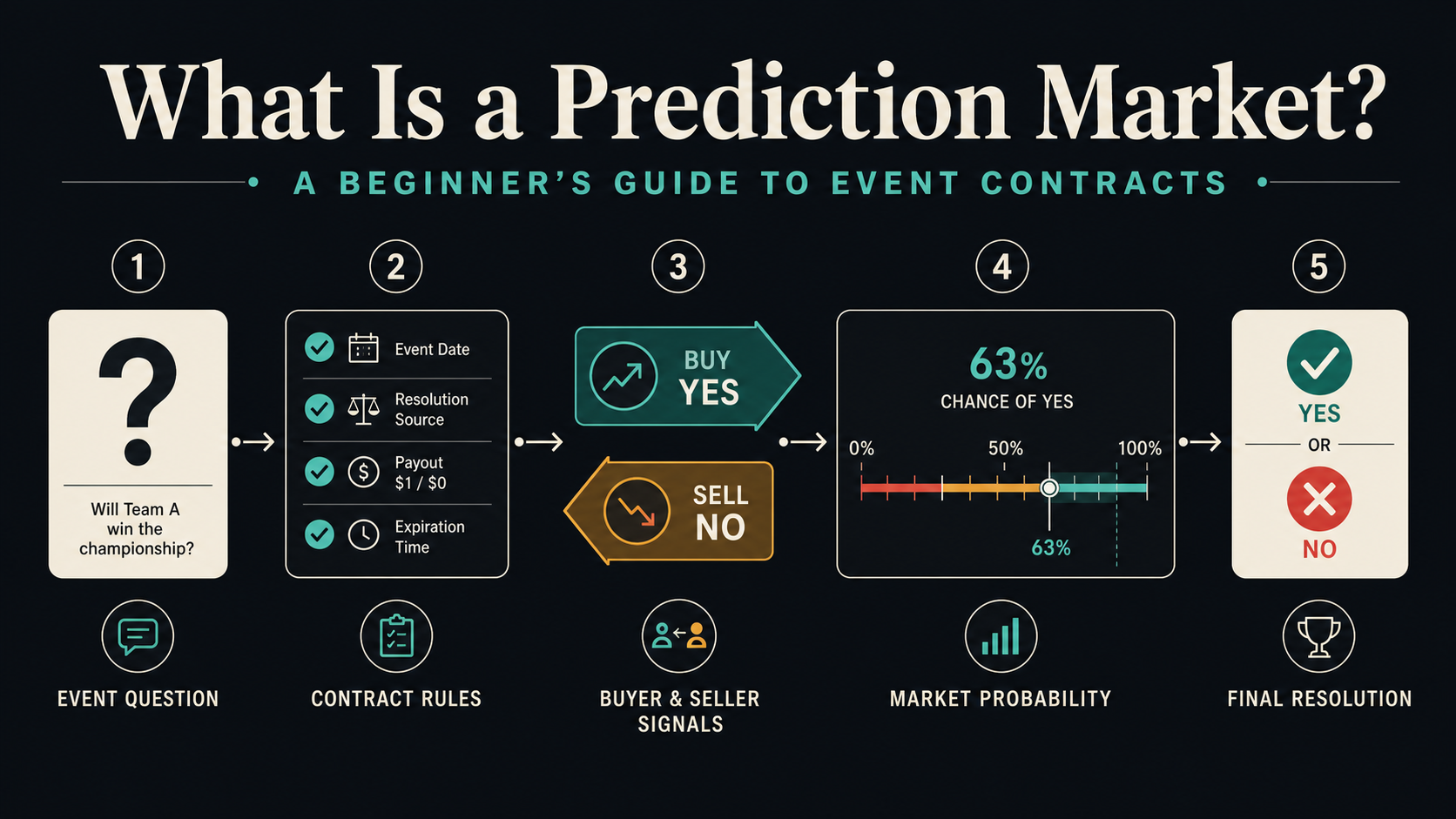
Everything starts with the wording of the contract. A good event contract is precise, time-bound, and observable. It usually asks a yes-or-no question with a settlement source already defined. For example: “Will the city officially approve the transit measure by December 31, 2026?” That wording matters because traders are not arguing in the abstract. They are trading the exact contract terms, including the deadline and the rule used to decide the outcome.
For a beginner, this is the first habit to build: read the full contract before looking at the price. Two contracts that sound similar can settle differently if they use different dates, different definitions, or different official sources. The contract text is the foundation of everything that follows.
How Yes and No prices work
Many prediction markets present a contract as Yes and No. If the event happens under the listed rules, the Yes side settles at a fixed value and the No side settles at zero. If the event does not happen, the reverse occurs. Before settlement, the Yes price moves up and down as traders react to new information and place orders.
Beginners often find this easiest to understand in simple terms: the market price is the current trading level for that outcome, not a promise. If a Yes contract trades higher than it did yesterday, that usually means traders as a group are more willing to pay for that outcome than before. If it trades lower, the market is less willing. The number is a live signal created by buying and selling, not a certainty and not a guarantee.
| Part | What a beginner should notice |
|---|---|
| Question | Is the event clearly defined and easy to verify? |
| Deadline | Exactly when does the contract stop being about the future? |
| Settlement source | Which official source or rule decides the result? |
| Price | What is the market currently willing to pay for Yes or No? |
| Change over time | Did the price move because of new information, liquidity, or both? |
Why people trade these contracts
People trade for different reasons. Some want exposure to a particular outcome. Some believe the current price is too high or too low. Others want to express a view based on research they think the broader market has not fully absorbed. The key idea is that a prediction market gathers different beliefs and pieces of information into one place where they affect price.
Information aggregation in plain English
“Information aggregation” sounds technical, but the basic idea is simple. Different people notice different facts. One trader may follow legislation closely. Another may understand polling methods. Another may focus on timing, wording, or legal procedure. When these people trade against one another, the price can become a rough summary of what the market currently believes about the contract. That is one reason prediction markets are educational: they force participants to connect claims with a precise outcome and a real-time price.
A practical example for beginners
Imagine a contract that asks: “Will the national weather agency declare July 2027 the hottest July on record?” The contract includes the exact data source and publication rule. At first, the Yes side trades at a moderate level. Over time, seasonal forecasts, monthly temperature reports, and public statements lead traders to revise their views. If new evidence appears to support the event, more people may want the Yes side, pushing its price upward. If later data weakens that case, the price may fall again.
Notice what this example teaches. The contract is not asking whether summer feels hot in one city or whether social media is talking about heat. It asks whether a named institution will report a specific record according to its own methodology. That distinction helps beginners avoid a common mistake: trading the story in their head instead of the contract on the screen.
How settlement works
Settlement is the moment when the market stops being a moving estimate and becomes an official outcome. Once the event deadline passes and the listed resolution source confirms the result, the contract pays according to its rules. For a yes-or-no contract, that means one side settles to its defined full value and the other side settles to zero.
This is why contract design matters so much. If the wording is vague, settlement can become confusing. If the wording is clear, settlement becomes much easier to understand. For beginners, settlement is the part that turns a price signal into a finished result.
What the market price can tell you
A market price can be useful as a compact snapshot of current market belief about a specific event contract. It can help you compare how traders view different outcomes, see how sentiment changes after new information, and understand how uncertainty narrows or widens over time. For learning, it is often more useful to watch how and why a price changes than to stare at a single number.
What it cannot tell you
A market price cannot remove uncertainty. It cannot guarantee that the crowd is right. It cannot tell you whether a contract is well designed unless you read it. It also cannot explain every move by itself, because prices can be influenced by participation levels, timing, and short-term reactions as well as deeper information. Beginners should treat price as a signal worth interpreting, not as an unquestionable truth.
Beginner checklist before you interpret any contract
- Read the full contract wording from start to finish.
- Confirm the exact deadline and timezone if listed.
- Check the settlement source or resolution rule.
- Separate the contract terms from headlines or opinions.
- Ask what new information could realistically move the price.
- Remember that a price is a market signal, not a certainty.
FAQ
Is a prediction market the same as a poll?
No. A poll collects stated opinions at one moment, while a prediction market continuously updates through trading around a defined contract.
Why does contract wording matter so much?
Because settlement depends on the exact wording, date, and source. Similar topics can lead to different outcomes if the rules differ.
Does a higher price mean the event will definitely happen?
No. A higher price only shows that the market currently assigns greater weight to that outcome than before or than the opposite side.
Final practical takeaway
If you are new to prediction markets, start with the contract text, not the excitement around it. Learn the event definition, the deadline, the settlement source, and the reason the price is moving. When you understand those four pieces, a prediction market becomes much easier to read as an educational tool for thinking about uncertainty and public information.
What to read next
This article is for educational purposes only and should be used to understand how event contracts and market signals work, not as a guarantee about any future outcome.