
Why Long-Horizon AI Benchmark Markets Reprice Around Threshold Evidence
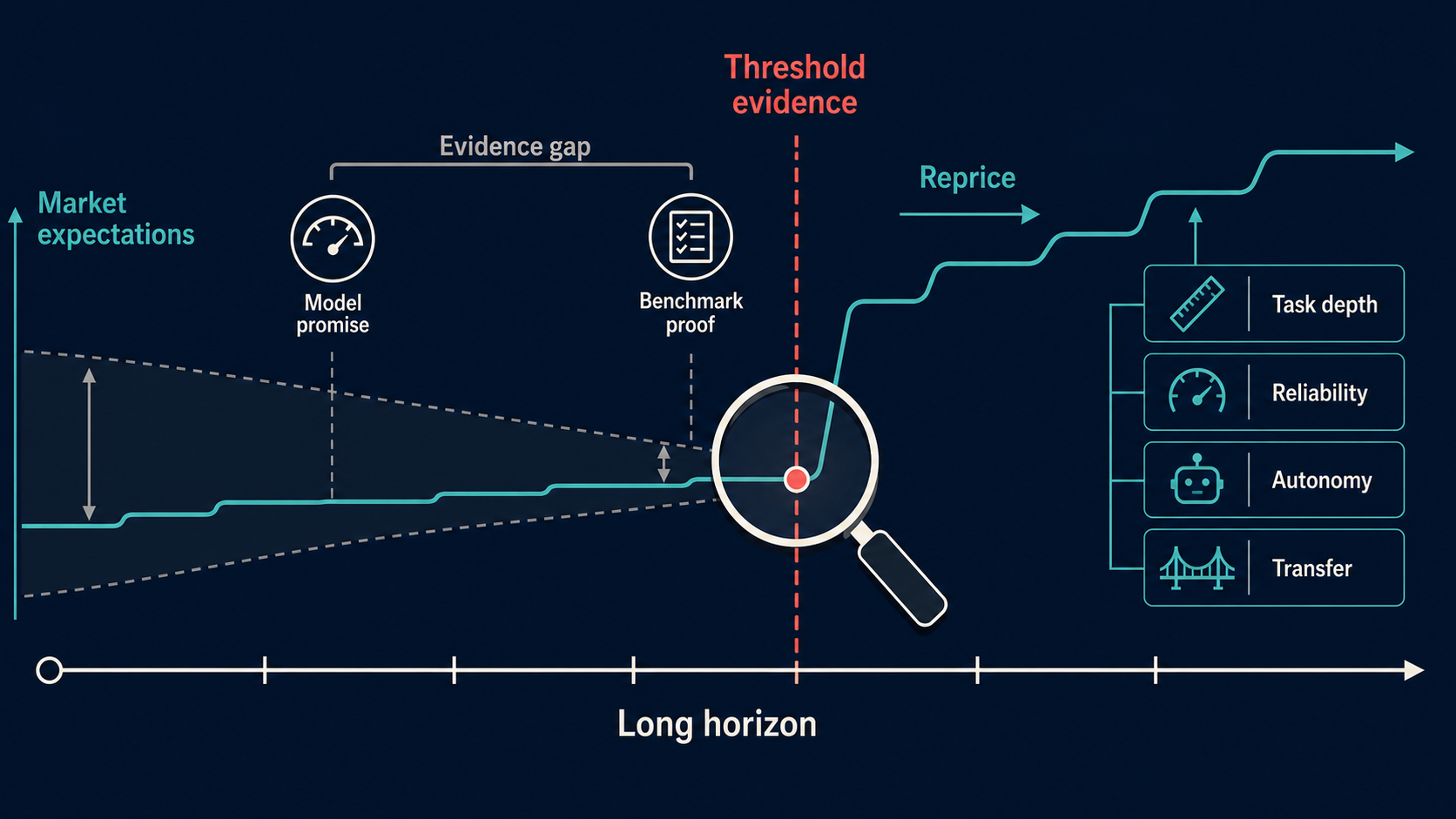
On current Polymarket Breaking boards, some technology contracts are less about today’s headline and more about distant benchmark thresholds. The repricing comes from whether new evidence narrows the gap between current capability and the exact score or threshold in the contract.
Why this article exists now
This article exists now because current Polymarket Breaking boards are clustering around the same repricing logic. The useful beginner move is to stop reading these as isolated headlines and start reading them as examples of one repeatable market mechanism.
How this explainer was built
This explainer uses current Polymarket Breaking questions as examples, then abstracts the repeatable mechanism behind them. It is not a prediction, endorsement, or betting recommendation. The goal is to help beginners read contract wording, timing, and evidence quality more clearly.
Current pattern on Breaking
The visible pattern right now is a cluster of AI benchmark or capability-threshold contracts where traders are repricing the evidence path toward a specific score, not merely the calendar deadline.
- Will any AI model reach 1550 Math Arena Score by December 31, 2026?
On the surface this looks like a headline market. Underneath, it is a long horizon benchmark threshold case where traders are repricing the narrowing contract path rather than just reacting to vibes.
The mechanism evidence is that the board cares less about general relevance and more about whether the exact Yes route still exists in time.
What the market is actually repricing
The mechanism evidence is that benchmark markets care about credible score signals, model-release cadence, and benchmark definitions before the final deadline is close.
- benchmark contracts need credible evidence that a model can clear the exact threshold
- markets reprice when new releases or evaluations narrow the gap to the target score
- the benchmark definition matters as much as the broad AI capability narrative
Diagnostic framework
| What to check | Why it matters | Beginner mistake to avoid |
|---|---|---|
| Ask what exact benchmark, score, or evaluation rule the contract uses. | This tells you whether the contract path is still alive, not just whether the headline is interesting. | Treating a broad story as enough evidence for the exact contract. |
| Check whether recent model evidence actually narrows the gap to that threshold. | This tells you whether the contract path is still alive, not just whether the headline is interesting. | Treating a broad story as enough evidence for the exact contract. |
| Do not confuse broad AI hype with contract-specific benchmark evidence. | This tells you whether the contract path is still alive, not just whether the headline is interesting. | Treating a broad story as enough evidence for the exact contract. |
What beginners usually misread
The beginner mistake is to read a sharp move like pure drama or pure fresh information. In most Breaking-style contracts, the better explanation is that the market has started pricing a narrower path structure. That is why a contract can feel calm one day and brutally decisive the next.
What this move does not prove
It does not prove a model release is guaranteed. It usually proves the market has updated how much credible evidence exists for clearing the exact benchmark threshold.
How to read the next one better
- Ask what exact condition still needs to happen for Yes to resolve.
- Ask how many realistic paths remain, not just whether the story still feels alive.
- Do not confuse broad relevance with contract relevance.
- Treat disappearing time as real information, not just background context.
What to read next
Use this as a reading path: identify the contract trigger, identify the remaining time window, then identify how many realistic Yes-paths are still alive before you infer anything from the price move.
- Ask what exact benchmark, score, or evaluation rule the contract uses.
- Check whether recent model evidence actually narrows the gap to that threshold.
- Do not confuse broad AI hype with contract-specific benchmark evidence.
- Start with What Is a Prediction Market? A Beginner’s Guide to Event Contracts
- Browse the PredictionMarket.zone beginner guides
- Browse the complete PredictionMarket.zone article library