
How to Read Prediction Market Prices, Odds, and Probabilities
Prediction market prices can look simple at first glance: a contract trading at 60 cents seems to say there is a 60% chance of something happening. That basic reading is useful, but beginners often stop there and miss the most important part. A market price is not a statement of certainty. It is a changing estimate shaped by the traders active at that moment, the rules of the contract, and the information currently being weighed. If you learn to read prices carefully, you can turn a confusing number into a practical summary of what a market is implying right now.
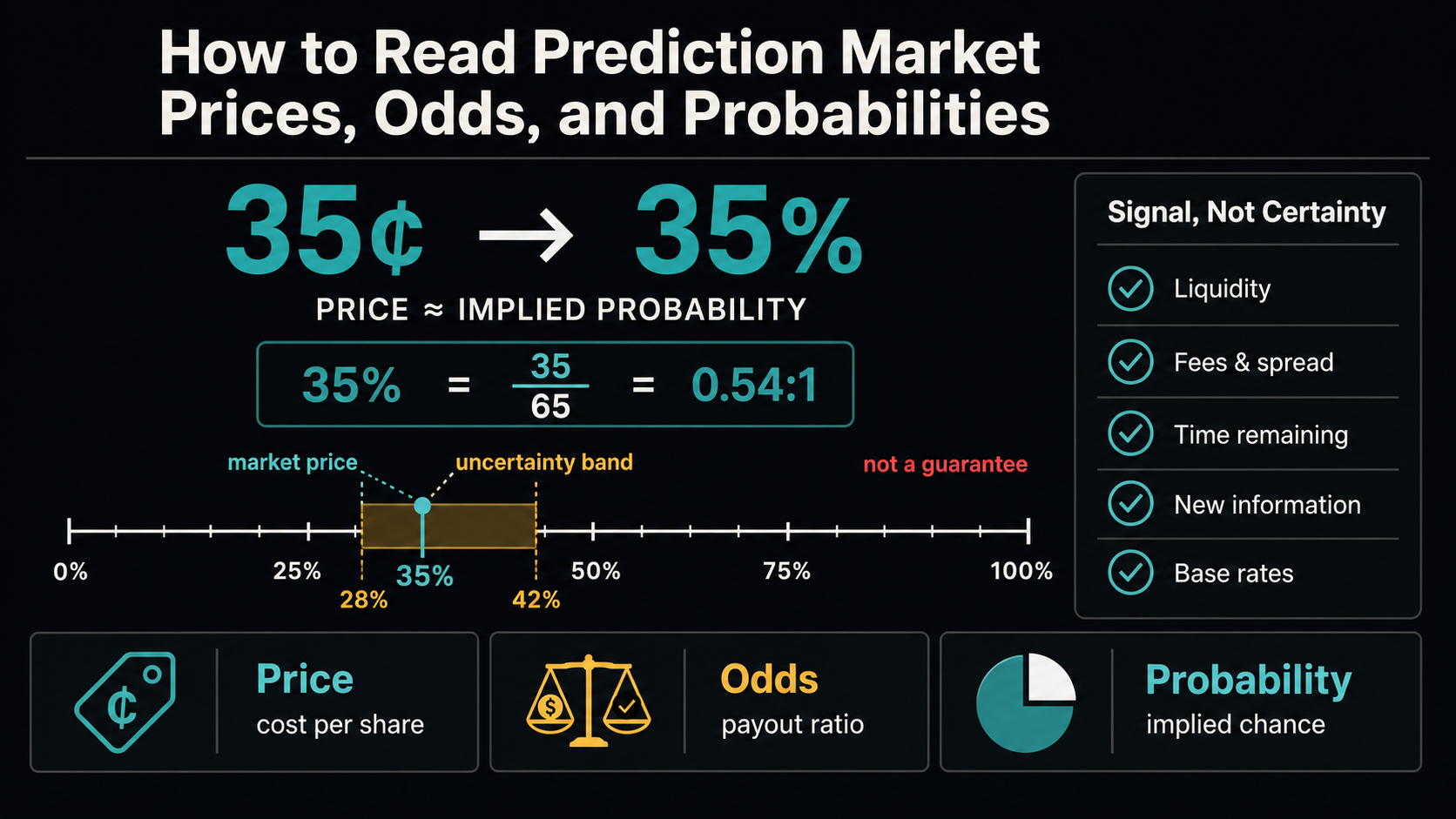
This guide explains how to convert cents into implied probability, how to read a contract conditionally, why price movement matters more than a single snapshot, and how to stay calibrated when you see a market that looks very confident. The goal is not to treat markets as magic truth machines. The goal is to read them clearly, ask better questions, and avoid common beginner mistakes.
Start with the basic conversion
In many yes-or-no prediction markets, a price in cents can be read as an implied probability in percentage terms. A contract at 25 cents implies about a 25% chance. A contract at 50 cents implies about a 50% chance. A contract at 78 cents implies about a 78% chance. This is the first habit to build: read the number as a probability estimate, not just as a price tag.
That said, the estimate only makes sense if you also understand the contract terms. A market is not pricing a vague idea like “Will this seem likely?” It is pricing a specific resolution condition. The wording might depend on an official source, a deadline, or a narrow definition of what counts as success. Before trusting the number, read the question as if you had to settle it yourself.
A quick probability table
| Market price | Implied probability | Simple reading |
|---|---|---|
| 10¢ | 10% | Unlikely, but clearly possible |
| 35¢ | 35% | Meaningful chance, still more likely not to happen |
| 50¢ | 50% | Roughly even odds |
| 75¢ | 75% | Favored, but not certain |
| 90¢ | 90% | Very likely, though still not guaranteed |
Read every market conditionally
A common beginner error is to read a market as a universal truth claim. Markets do not say, “This event will happen.” They say something closer to, “Given the contract wording and the information currently reflected in trading, this event is being priced around this probability.” That conditional interpretation matters because markets can be wrong, thinly traded, early, or built around narrow rules.
For example, a contract at 80 cents does not mean “done deal.” It means the market is implying about an 80% chance under its own rules. In plain language, that still leaves real room for the other outcome. Out of ten situations priced around 80%, you would still expect some to fail. Reading the price conditionally helps you stay humble and prevents you from turning probability into certainty.
Movement often tells you more than a snapshot
One price by itself is only a snapshot. The more useful question is often: what changed? If a market moves from 42 cents to 58 cents, the important signal is not just that it is now above 50%. The signal is that the implied probability increased by 16 percentage points. That kind of move tells you the market revised its view in a noticeable way.
Beginners sometimes treat a high number as automatically more meaningful than a large change. In reality, a move from 20 cents to 35 cents may be more informative than a market sitting at 82 cents all day. Why? Because movement hints that new information, new interpretation, or stronger conviction entered the market. A static number is easy to overread. A changing number gives you a story to investigate.
Practical example: reading a move without overreacting
Imagine a market asks whether a policy proposal will be officially approved by a stated deadline. On Monday it trades at 30 cents. By Wednesday it rises to 45 cents. By Friday it reaches 62 cents. A beginner might say, “It is going to happen.” A better reading is: “The market moved from implying a 30% chance to a 62% chance over the week, so traders became much more confident, but the outcome is still far from certain.” That interpretation keeps both facts in view: the probability increased a lot, and uncertainty still remains.
Notice how the same example can be useful even if you know nothing about the underlying topic. You can still read the market structurally. First convert the price into implied probability. Then compare it with the earlier price. Then ask what information might explain the shift. This gives you a disciplined way to read markets instead of reacting emotionally to a single headline number.
Calibration matters more than confidence
Calibration means matching confidence to reality over time. If something is priced at 70%, that should not be interpreted as “basically certain.” It should be read as an event that would happen around seven times out of ten in similar situations. Good readers stay aware of that difference. They do not flatten all high probabilities into guarantees, and they do not dismiss low probabilities as impossible.
This is especially important near the extremes. A market at 95 cents can still resolve the other way. A market at 5 cents can still surprise everyone. Once you think in calibrated ranges, market numbers become more useful and less dramatic. You stop asking, “Will this happen, yes or no?” and start asking, “How strong is the market’s current lean, and how much uncertainty is still left?”
A simple checklist for reading any market
Use this checklist before you form an opinion about what a market price is telling you:
- Read the exact question and resolution terms, not just the headline.
- Convert the price in cents into implied probability.
- Ask whether you are looking at a snapshot or a recent move.
- Compare the current price with an earlier reference point.
- Remember that high probability is not certainty and low probability is not impossibility.
- Describe the price conditionally: what the market is implying now, under these rules.
- Separate the market signal from your emotional reaction to the number.
FAQ
Does a 60 cent market mean the event will happen?
No. It means the market is implying about a 60% chance under the contract’s stated conditions. That is a lean, not a guarantee.
Why can markets be wrong?
Markets reflect the information and judgments available through trading, not perfect knowledge. They can misread events, react slowly, or overweight weak signals.
What should beginners focus on first?
Focus on three habits: convert price to probability, read the contract carefully, and pay attention to movement over time rather than a single isolated number.
Final practical takeaway
The best beginner mindset is simple: a prediction market price is a probability estimate, not a promise. Read 40 cents as 40%, 70 cents as 70%, and 90 cents as very likely rather than certain. Then ask what exactly is being resolved, how the price has moved, and how much uncertainty still remains. If you build that habit, prediction markets become easier to understand and much harder to misread.
What to read next
This article is for education only and explains how to interpret market prices as probability signals, not as certain outcomes or personal advice.