
Prediction Market Resolution Rules: Contracts, Deadlines, and Sources
Many beginners focus on the headline of a market question and ignore the fine print. That is usually a mistake. In prediction markets, the contract text decides what counts as a win or loss, not the trader’s assumption about what “should” happen. A market can look simple on the surface, yet resolve in an unexpected way because of one phrase, one deadline, or one specified source. Learning to read resolution rules carefully is one of the most practical skills a new participant can build.
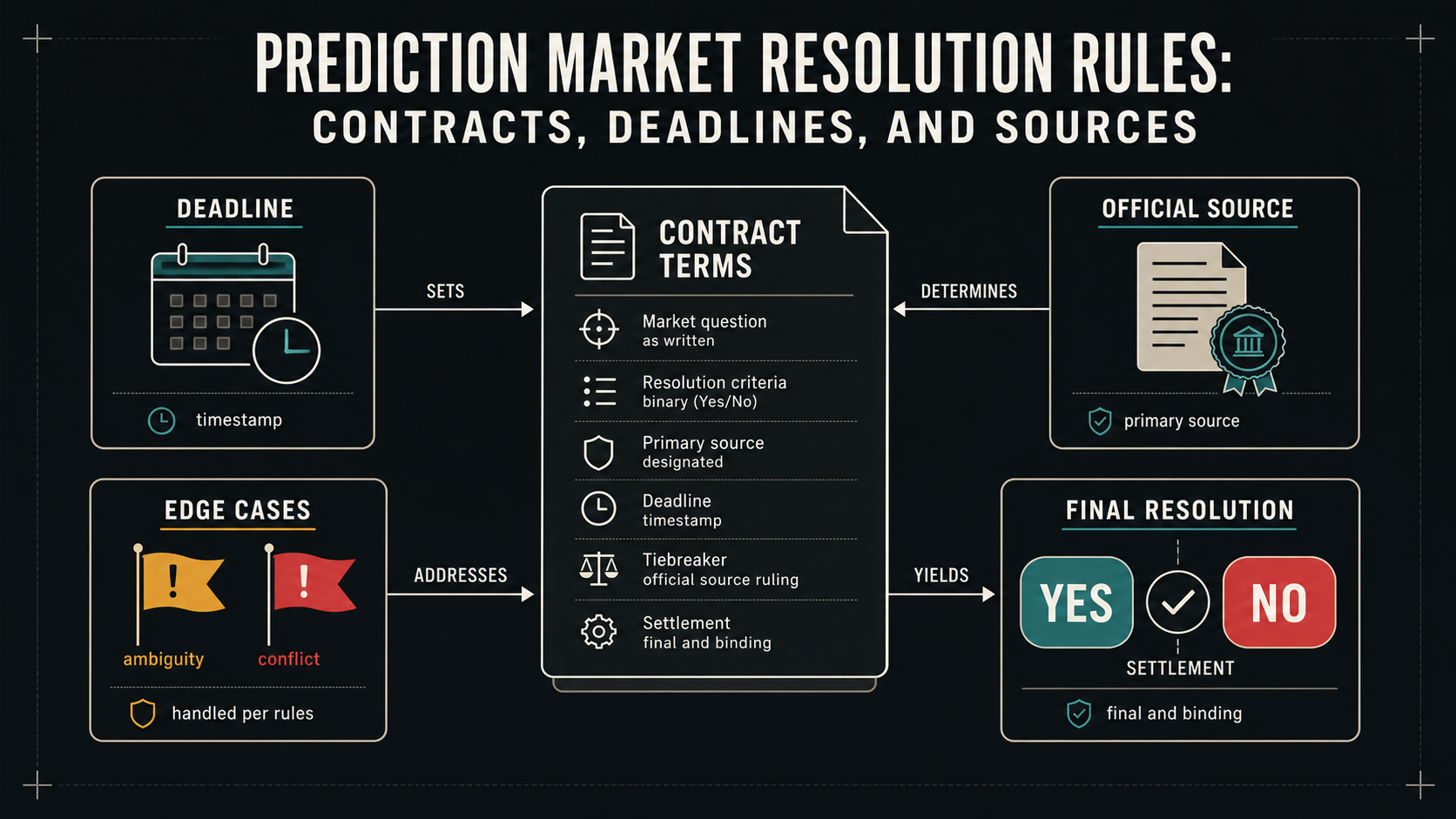
Resolution rules matter because they define the event with legal-style precision. They explain what outcome is being measured, when observation stops, where the final answer comes from, and how unusual situations are handled. If any of those pieces are vague, participants can interpret the same market differently. A careful reader is simply checking the actual contract before taking it seriously.
Why contract wording matters more than the headline
The headline is only a summary. The binding meaning usually comes from the fuller rules below it. Words such as “announced,” “completed,” “official,” “reported,” or “by” can change the outcome completely. For example, “Will a bridge open by June 30?” is not the same as “Will the government announce by June 30 that the bridge is open?” One refers to the event itself. The other refers to a statement by a named authority. Those may sound close, but they can resolve differently.
Exact wording also affects what evidence counts. If the rules say “official final results,” then early media reports may not matter. If the rules say “according to the first statement published by a named agency,” then later corrections might not matter unless the contract says they do. Beginners often think common sense will fill in the gaps. In practice, markets work best when common sense is backed by explicit text.
Deadlines, sources, and edge cases
Every resolution rule should answer three basic questions: what happened, by when, and according to whom. The cutoff time determines whether events after a deadline count. The resolution source determines who gets to define the official answer. Edge-case language determines what happens when reality is messy.
Cutoff times are especially important because real events do not always fit neat calendar lines. A contract may say “by 11:59 PM Eastern Time on September 30.” That is much clearer than saying “by the end of September.” Time zones, daylight saving changes, and publication delays can all matter. If a source posts an update one minute after the deadline, the contract may resolve differently than many traders expect.
Resolution sources are equally important. A good contract names a specific authority or document type, such as an official government release, a court docket, a company filing, or a final certified report. Without a named source, participants may argue over whether a news article, press conference, social media post, or leaked document should count.
Edge cases cover awkward situations: delayed certification, contradictory statements, data revisions, cancellations, renamings, partial completion, or force majeure events. These details may feel boring at first, but they often decide the result when reality refuses to stay tidy.
Quick reference table
| Rule element | Why it matters | Common beginner mistake |
|---|---|---|
| Exact wording | Defines the event precisely | Assuming the headline says enough |
| Cutoff time | Sets the last moment that counts | Ignoring time zone or publication timing |
| Resolution source | Names the authority for settlement | Trusting unofficial reports |
| Edge cases | Handles messy real-world scenarios | Assuming unusual cases will be obvious |
| Dispute process | Explains how disagreements are reviewed | Not checking what happens if a ruling is challenged |
A neutral fictional example
Imagine a fictional contract that asks: “Will the City Transit Authority officially open the Harbor Line extension to passengers by 6:00 PM local time on August 1, 2027?” The rules add that resolution will be based on the first public notice posted on the authority’s official website. They also state that test rides do not count, ceremonial ribbon cuttings do not count unless passenger service begins, and service interruptions after opening do not reverse a Yes result.
Now imagine this sequence. At 3:00 PM, city officials hold a celebration and say the line is ready. At 5:40 PM, invited guests board a preview trip. At 5:58 PM, the authority publishes a notice saying regular passenger service begins immediately. At 6:20 PM, local news outlets report delays because one station entrance is still closed. Under the rules above, the likely result is still Yes, because the named authority officially announced passenger opening before the deadline, preview rides were excluded, and later service problems did not undo the opening once it happened.
This example shows why beginners should not rely on fragments of news or on what feels fair in conversation. The result depends on the contract structure: official opening, named source, exact deadline, and stated treatment of partial complications.
Ambiguity and dispute processes
Even well-written contracts can face ambiguity. A source may publish conflicting updates. A government body may change terminology. Sometimes the event happens, but the specified source never states it in the expected form. When that happens, dispute procedures matter because they tell participants how evidence is reviewed and how a final determination is reached.
A sound dispute process does not guarantee that every participant will agree with the outcome. It does, however, reduce uncertainty about how disagreements are handled. Good processes explain who can challenge an initial ruling, what evidence can be submitted, how long review takes, and whether an appeal is possible. If you would feel uncomfortable explaining how a disputed market would be settled, you probably have not read the contract closely enough.
Pre-trade contract-reading checklist
Before taking a position, pause and run through this checklist:
- Can you restate the event in one precise sentence without changing its meaning?
- Do you know the exact cutoff date, time, and time zone?
- Is the resolution source clearly named and reasonably authoritative?
- Do the rules explain whether revisions, corrections, or delayed publications count?
- Do they say what happens if the event is partially completed, renamed, postponed, or cancelled?
- Do you understand whether unofficial reports are ignored unless confirmed by the named source?
- Have you read the dispute or appeal process in case the first ruling is contested?
- Would you still understand the contract if the headline disappeared and only the rules remained?
FAQ
Is the headline enough to understand a market?
No. The headline is a shorthand label. The full rules define the actual contract.
Why does the named source matter so much?
Because settlement needs a shared reference point. Without a named source, different participants may rely on different evidence.
What if the real-world event seems obvious but the contract text is narrow?
The contract text still matters most. Markets resolve according to their rules, not according to the broadest public interpretation.
Final practical takeaway
For beginners, the safest habit is to treat every market like a small written agreement. Read the full wording, identify the deadline, confirm the source, scan for edge cases, and check the dispute process before you form a view. That routine will not remove all uncertainty, but it will help you avoid misunderstandings that come from reading only the surface of a contract.
What to read next
This article is for educational purposes only and explains how market resolution rules work; it is not a recommendation to trade or a statement about future outcomes.