
How to Use AI for Prediction Market Research Without Outsourcing Judgment
AI can make prediction market research faster, but speed is not the same as judgment. A beginner can easily mistake a smooth summary for a reliable conclusion, especially when the contract is unclear, the source trail is weak, or the facts have changed since the summary was written. The safest way to use AI is not to let it decide for you. Use it to structure messy information, surface missing pieces, and pressure-test your own thinking.
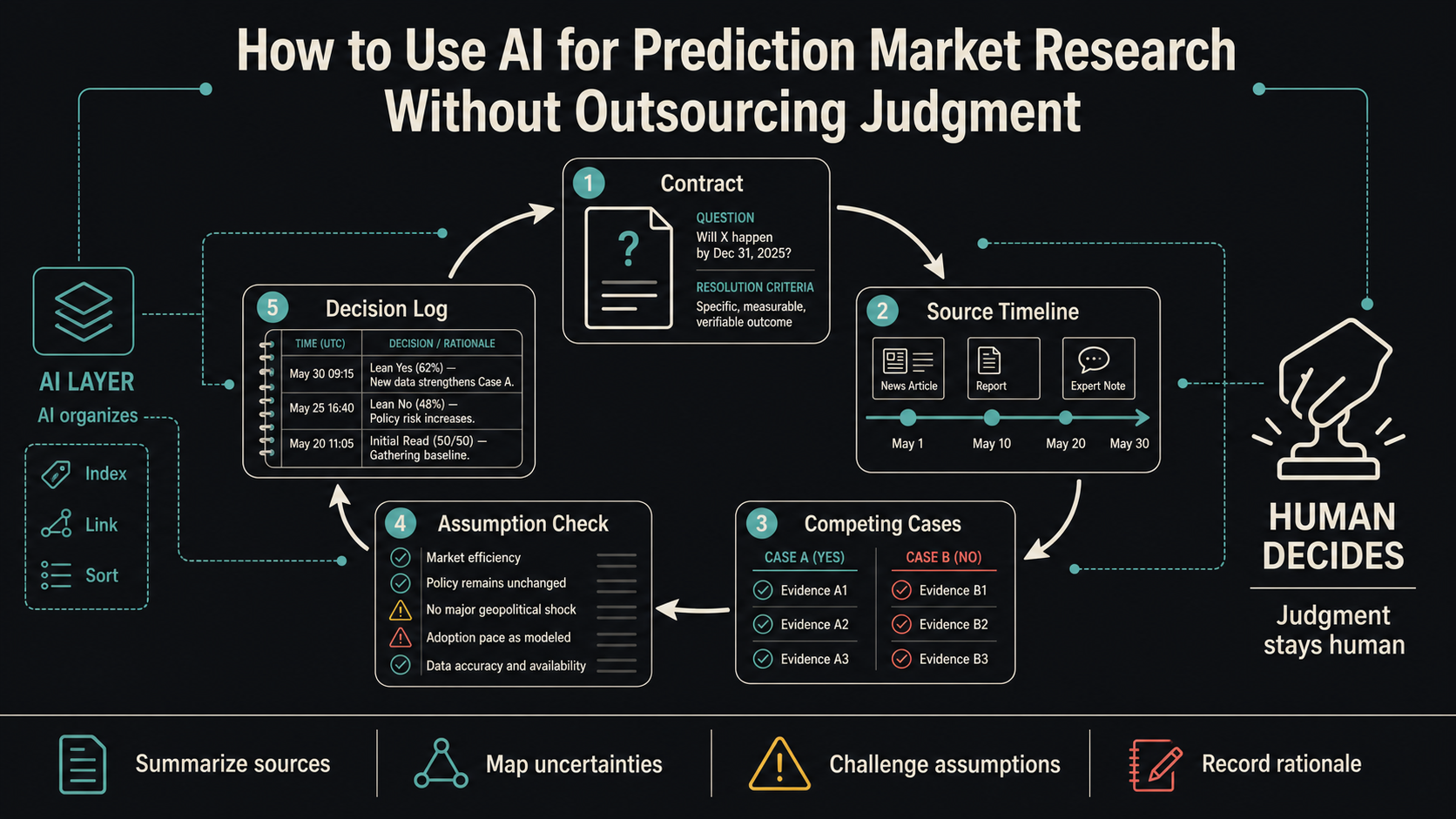
A practical workflow starts with the contract itself, then moves through a source timeline, case comparison, change tracking, assumption checks, and a written decision log. This keeps you grounded in evidence instead of impressions. It also helps you notice the four biggest risks: hallucination, stale data, poor sourcing, and automation drift. When you know where those risks enter the process, you can use AI as an assistant rather than a substitute.
The core idea: let AI organize, not conclude
Prediction market contracts often look simple until you read the resolution criteria carefully. Small words such as official, announced, before, or by the end of the month can completely change what counts as relevant evidence. AI is useful for restating language, extracting timelines, and sorting documents by topic, but it should not be trusted to resolve ambiguity on its own. Your first job is to understand what question is actually being asked.
A repeatable workflow for AI-assisted research
1. Parse the contract before gathering facts
Start by rewriting the contract in plain language. Identify the event, the deadline, the resolution source, and any words that could be interpreted in more than one way. Then ask AI to list the unresolved terms, not the answer. If the contract says an event must be officially confirmed, note that rumors, leaks, and even credible reporting may still be insufficient. This step prevents a common beginner mistake: researching the surrounding story instead of the exact claim that will resolve the market.
2. Build a source timeline instead of a pile of links
Once the contract is clear, gather sources in chronological order. AI can help turn scattered notes into a timeline with dates, claims, and source types. This matters because prediction questions often evolve. A statement that looked decisive two weeks ago may have been corrected, delayed, or narrowed later. A timeline helps you separate first reports, official statements, follow-up clarifications, and final outcomes. It also makes stale information much easier to spot.
3. Compare similar past cases carefully
Beginners often search for a single analogy and stop there. A better approach is to compare two or three relevant cases and note both similarities and differences. Ask AI to create a comparison grid: what happened, what counted as confirmation, how long resolution took, and where the comparison breaks down. The point is not to find a perfect precedent. The point is to train your eye to see which features are truly comparable and which are just convenient storytelling.
4. Track changes, not just snapshots
Many research errors come from treating information as static. Policies change, deadlines move, spokespersons revise language, and documents get updated quietly. Use AI to summarize what changed between versions of a statement or between earlier and later reports. Then verify the change directly in the source. This helps guard against stale-data risk, where an accurate summary becomes misleading simply because time has passed and the underlying facts moved on.
5. Challenge assumptions on purpose
After AI helps you organize the evidence, ask it to argue against your current view. Request the strongest alternative interpretation of the contract, the weakest link in your source chain, and the most likely reason your conclusion could fail. This is one of the best uses of AI because it reduces confirmation bias. Still, treat the output as prompts for inspection, not as final rebuttals. A bad counterargument can be just as misleading as a bad summary if you accept it uncritically.
6. Keep a decision log you can revisit
Write down what you believe, why you believe it, what sources support it, what would change your mind, and what remains uncertain. This decision log is where judgment lives. AI can help format it, but you should supply the actual reasoning. A good log turns vague confidence into explicit claims. Later, when new evidence appears, you can compare it against what you previously thought instead of quietly rewriting your memory.
| Step | What AI can do | What you must verify |
|---|---|---|
| Parse contract | Restate terms and flag ambiguity | Resolution wording and deadlines |
| Build timeline | Sort events and summarize updates | Dates, source order, missing gaps |
| Compare cases | Create side-by-side comparisons | Whether the analogy truly fits |
| Track changes | Highlight revisions across sources | What changed and why it matters |
| Decision log | Format notes into a clear record | Your reasoning and uncertainty |
Practical example: a deadline with shifting language
Imagine a market asks whether a public agency will announce a new policy by a certain date. Early coverage says the policy is expected soon. A later interview suggests the timing may slip. Then an official calendar update removes the item entirely. AI can help summarize these developments, but the key question is not whether the policy seems likely. The key question is whether an official announcement matching the contract language appears before the deadline.
In this example, a disciplined workflow would note the contract wording, place each report on a timeline, separate expectation from confirmation, compare with past cases where agencies previewed actions before formal release, and record what would count as decisive evidence. If you let AI jump straight to a conclusion, it may overweight early optimistic reports. If you keep control of the timeline and the criteria, you are much less likely to confuse noise with resolution-relevant evidence.
The four risks to watch every time
Hallucination risk
AI may invent details, merge separate events, or present uncertainty with unjustified confidence. Never rely on an unattributed claim. If a statement matters, trace it back to the source yourself.
Stale-data risk
A summary may be accurate when written and misleading later. Date every note, and prefer timelines over isolated snippets so you can see whether the situation has changed.
Source risk
Not all sources answer the same question. Commentary, rumor, screenshots, and secondhand summaries can be useful leads, but they are not equal to primary documentation or official statements.
Automation risk
When templates and prompts become routine, it is easy to stop noticing when the situation no longer fits the workflow. Keep a manual pause point before any conclusion: what is the strongest reason this process could be wrong today?
Actionable checklist
- Rewrite the contract in plain English before researching.
- Mark the deadline, resolution source, and ambiguous terms.
- Build a dated timeline from primary and secondary sources.
- Separate confirmed facts from expectations and commentary.
- Compare at least two similar past cases and note limits.
- Check whether any source has been updated or contradicted.
- Ask AI for the strongest counterargument to your view.
- Write a decision log with evidence, uncertainty, and triggers that would change your mind.
FAQ
Should beginners use AI at all?
Yes, but mainly for organizing information, clarifying wording, and surfacing missing questions. Do not treat it as a final authority.
What is the biggest mistake to avoid?
Starting with the news story instead of the contract language. If you misunderstand the resolution criteria, better summaries will not save you.
How do I know when AI helped rather than hurt?
If your notes become clearer, your sources become easier to audit, and your reasons are more explicit, AI helped. If you became more confident without becoming more specific, it probably hurt.
Final practical takeaway
The best way to use AI for prediction market research is to give it clerical work and keep interpretive work for yourself. Let it sort, compare, format, and question. You should still define the contract, judge the sources, track what changed, and maintain a decision log. That division of labor is what keeps convenience from turning into overconfidence.
What to read next
This article is for education only and is meant to improve research habits, source handling, and judgment discipline rather than provide forecasting or trading instructions.