How to Compare Prediction Market Platforms: A Beginner Checklist
If you are new to prediction markets, it is easy to get distracted by brand names, headlines, or a single market that looks active. A better approach is to compare platforms with the same checklist every time. That keeps you focused on practical questions: can you legally use it, how does money move in and out, what kinds of markets are available, how are outcomes resolved, and what protections exist if something goes wrong?
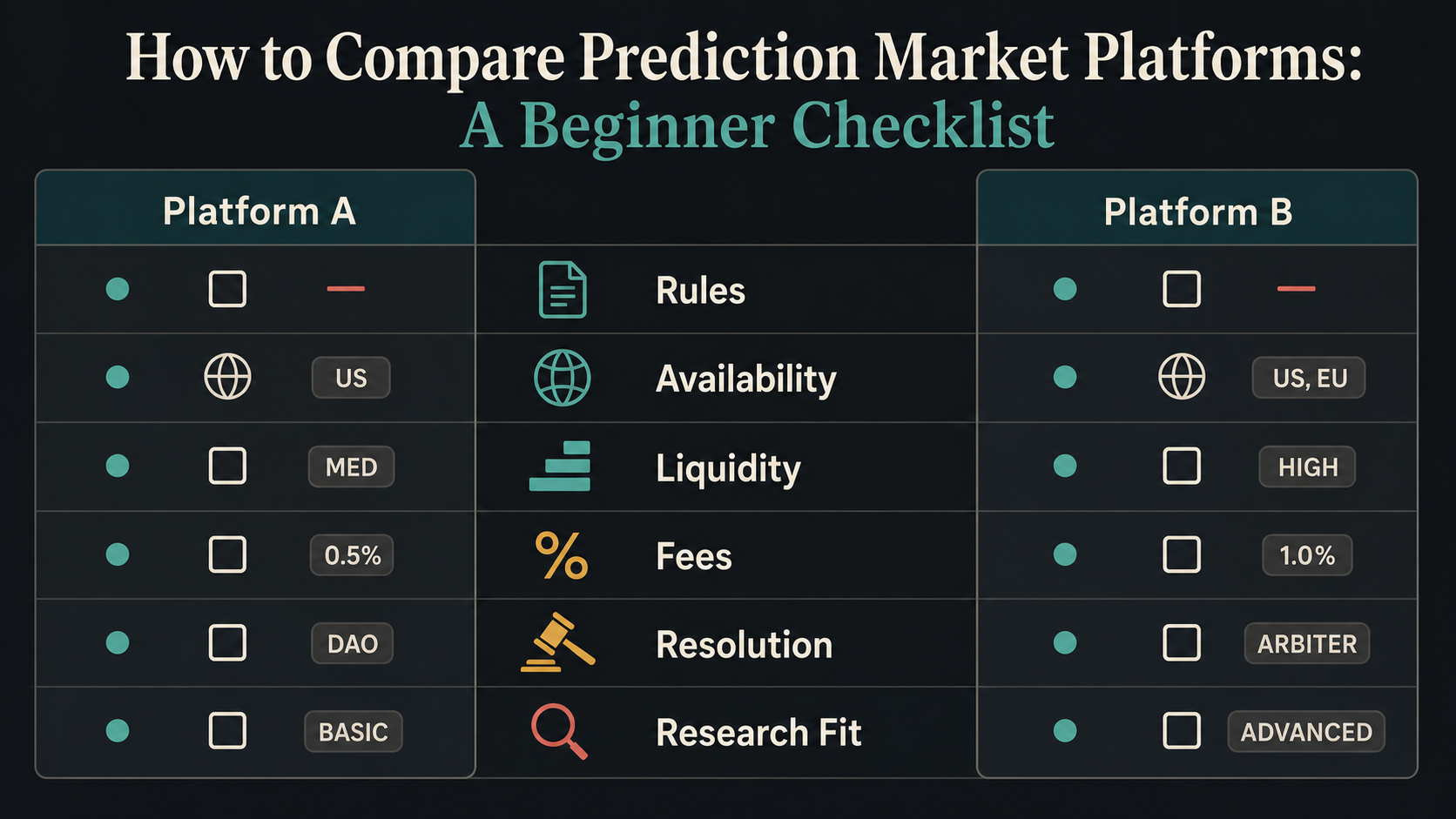
This guide gives you a durable framework instead of a ranking. The goal is not to tell you which platform is “best” for everyone. The goal is to help a true beginner evaluate any platform in a calm, repeatable way before opening an account or placing a first trade.
Start with access and basic fit
Before looking at features, confirm that the platform is actually available to you. Legal availability comes first because access rules can vary by country, state, or region. A platform may be visible on the web but still restrict registration, deposits, withdrawals, or trading based on location. Read the terms, supported jurisdictions, and identity requirements before doing anything else.
Next, check the account and funding model. Some platforms use a traditional sign-up flow with bank-style identity checks. Others may rely on digital wallets or third-party payment rails. For a beginner, the key question is simple: do you understand how to create an account, verify it, add funds, withdraw funds, and keep records? If the setup process feels confusing at the start, that friction may matter later when you need support or want to exit cleanly.
Questions to answer first
- Is the platform legally available where you live?
- What identity checks are required?
- How do deposits and withdrawals work?
- Are there minimum balances, settlement delays, or account limits?
- Can you clearly explain the full funding path to yourself in one minute?
Compare market quality, not just market quantity
A large number of listed markets does not automatically mean a better experience. What matters is whether the platform offers the kinds of topics you want to follow and whether those markets are active enough to use comfortably. Market coverage refers to the range of subjects available, such as politics, economics, sports, weather, technology, or culture. Liquidity refers to how easily participants can enter or exit positions without large price swings or long waits.
Beginners should pay close attention to liquidity because it affects usability more than marketing language does. A platform can look impressive on the surface, but if spreads are wide, depth is thin, or trades do not fill smoothly, it may be harder to learn from real participation. Look for signs that a market is active, orderly, and understandable rather than simply numerous.
| Category | What to check | Why it matters for beginners |
|---|---|---|
| Legal availability | Supported countries, local restrictions, verification rules | Prevents wasted setup time and access surprises |
| Funding model | Deposit methods, withdrawal steps, settlement timing | Shows how easy it is to start and exit responsibly |
| Market coverage | Topics, event types, contract clarity | Helps you find markets you can actually understand |
| Liquidity and fees | Bid-ask spread, depth, trading and withdrawal costs | Directly affects execution quality and total cost |
| Rules and resolution | Outcome wording, source policy, dispute process | Reduces confusion when an event ends |
| Safety and support | Security tools, account recovery, help response | Matters when something goes wrong |
Understand fees, rules, and resolution before you trust a market
Fees can be small on paper and still make a noticeable difference over time. Review every place a cost may appear: trading fees, spread costs, deposit charges, withdrawal charges, conversion costs, and inactivity or processing fees if they exist. A platform does not need to be the cheapest in every category, but the cost structure should be easy to find and easy to understand.
Rules matter just as much as fees. Read how markets are written, what counts as the final outcome, which sources are used for resolution, and how disputes are handled. Good platforms make their market rules plain. If wording is vague, if resolution sources are unclear, or if dispute handling is hard to find, that is a sign to slow down. Beginners learn faster on platforms where contract language is precise and the resolution process is transparent.
Practical example: comparing two hypothetical platforms
Imagine Platform A has many interesting markets and a polished interface, but its withdrawal process is multi-step, its fees are scattered across several pages, and its resolution rules are brief. Platform B has fewer markets, yet its account setup is clear, fees are summarized in one place, market wording is precise, and dispute handling is documented in detail. A beginner may learn more safely on Platform B, even if Platform A looks more exciting at first glance. This example shows why a structured checklist often beats first impressions.
Check data access, security, and support
Data access is important even for non-technical users. At a minimum, you should be able to review your open positions, account history, market history, and settlement records without confusion. If the platform offers exports, documentation, or an interface that makes records easy to review, that is a practical advantage. Clear data helps you learn from past decisions and keep your own notes.
Security should be evaluated in concrete terms. Look for strong passwords, two-factor authentication, session management, withdrawal protections, and clear account recovery procedures. No security system is perfect, but a serious platform should explain the tools users have to protect themselves.
Support is the final layer many beginners overlook. Ask yourself how you would get help if identity verification stalls, a withdrawal is delayed, or a market rule seems unclear. A useful support system usually includes a help center, direct contact paths, and enough documentation that common questions can be answered before they become stressful problems.
Your actionable beginner checklist
- Confirm the platform is legally available in your location.
- Read the account verification and funding steps from start to finish.
- Check whether the market topics match what you actually understand.
- Review liquidity signals instead of judging by market count alone.
- Write down all visible fees in one place before comparing options.
- Read one full market rule page and one resolution policy page.
- Test whether account history and transaction records are easy to review.
- Enable available security protections before funding an account.
- Find the support and dispute process before you need it.
- Set personal limits on time, deposits, and decision frequency.
Responsible-use limits matter more than beginners expect
A good comparison is not only about platform features. It is also about whether the platform helps you use it responsibly. Look for practical controls such as deposit limits, cooldowns, record visibility, or other tools that reduce impulsive decisions. Even if those tools are optional, their presence tells you something about the platform’s design priorities.
Just as important, create your own limits before you begin. Decide how much time you will spend, how often you will check markets, and what size of activity fits your learning goals. Beginners benefit from treating prediction markets as information tools that require discipline, not as fast-moving entertainment that demands constant attention.
FAQ
Do I need the platform with the most markets?
No. A smaller set of clearly written, active markets may be more useful for learning than a larger catalog with weak liquidity or unclear rules.
Why is resolution policy so important?
Because market outcomes only make sense if the rules, sources, and dispute process are clear before the event is resolved.
What is the simplest sign a platform may not fit a beginner?
If you cannot quickly explain how funding, fees, and resolution work, the platform may be too opaque for a comfortable first experience.
Final practical takeaway
When comparing prediction market platforms, do not ask which name is the most popular. Ask which platform is easiest for you to understand end to end: legal access, funding path, market quality, total costs, rule clarity, resolution method, account records, security protections, support, and personal limits. If you use that checklist consistently, you will make calmer and better-informed comparisons.
What to read next
This article is for educational purposes only and is not financial, legal, or trading advice. Always review local rules, platform terms, and your own risk limits before participating.